

Age past 10 years
A tank heater typically lasts 8 to 12 years. In Seagoville hard water, a tank that has never been flushed can fail in about 6. The rating plate on the side of the unit shows the install date.
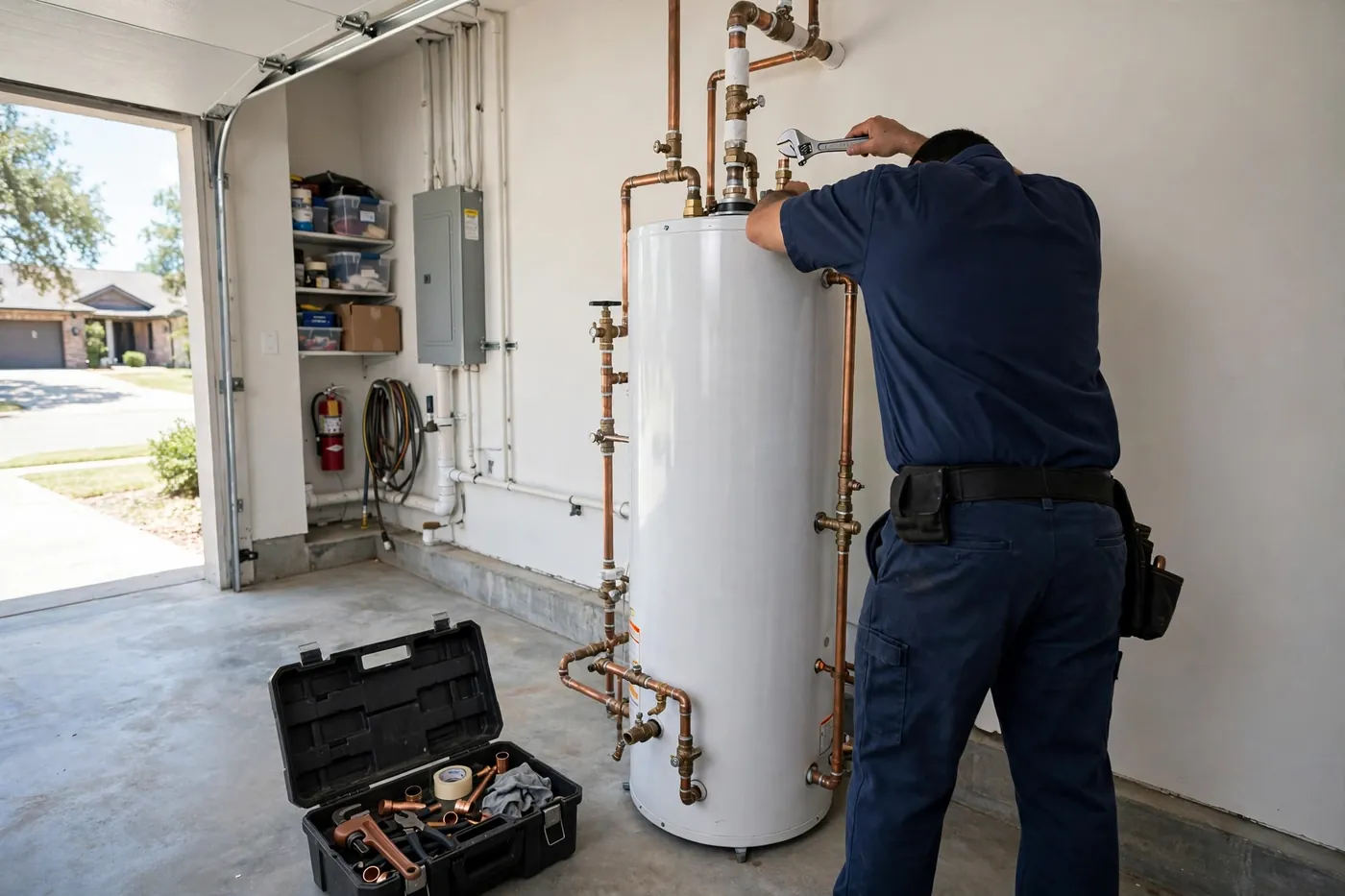
Most water heaters in Seagoville are replaced, not repaired, once they reach the end of their life. The median home here was built in 1990, and a tank that has never been flushed in hard water can fail years early. A replacement swaps the old unit for a new one, sized for the household today, with the permit, the inspection and the old heater's removal handled.
Open Mon-Fri, 7am-6pm
Call (833) 382-2711 for water heater replacement anywhere in Seagoville, TX. Most replacements are finished in a single visit: the old heater is drained and removed, the new unit is installed and connected, and the work is inspected. A permit and inspection are typically required in Seagoville.
If the tank itself is leaking, replacement is the only fix. If the fault is a part, such as a thermostat or an element, repair may be the better call. See water heater repair in Seagoville for the repair side of that decision.
One sign on its own may mean a repair. Two or three together, on a heater past ten years old, usually mean the end of its life. If you are seeing any of these in a Seagoville home, call and describe what you found.
A tank heater typically lasts 8 to 12 years. In Seagoville hard water, a tank that has never been flushed can fail in about 6. The rating plate on the side of the unit shows the install date.
Rust from the hot tap only points to the tank or the anode rod. Once the tank itself rusts through, it cannot be repaired, and the rust only gets worse.
A leak from the tank body means replacement. A leak from a fitting or a valve may still be a repair, which is why finding where the water starts matters.
Sediment boiling at the bottom of the tank makes these noises, and Seagoville hard water builds sediment fast. A flush helps early; years of buildup can mean the tank is done.
Sediment takes up space inside the tank and insulates the water from the heat. Showers run cold sooner than they used to, even though nothing else changed.
Scale forces the burner or the elements to work harder for the same hot water. A heater that costs more to run each year is usually a heater wearing out.
There is no single rule, because the answer depends on the fault and the age together. A cheap part on a young heater is a repair. A leaking tank is a replacement at any age. Everything in between is a judgement call, and the table shows how it usually goes.
The pattern matters more than any single fault. A heater that has needed two repairs in a year is telling you something, even if each repair was small. And a heater past ten years old with a major fault is rarely worth a large repair, because the next part to fail is usually not far behind.
When repair is the better call →| Situation | Usually the answer |
|---|---|
| Tank leaking from the body | Replace: a leaking tank cannot be repaired. |
| Pilot light or thermocouple fault | Repair: a part replacement, often quick. |
| Failed element or thermostat (electric) | Repair: the parts are replaceable. |
| Heater over 10 years with a major fault | Replace: another part will usually follow. |
| Rusty water from a young tank | Repair first: the anode rod may be the cause. |
| Repeated breakdowns | Replace: the pattern matters more than any single fault. |
A like-for-like replacement is usually finished in a single visit. Here is the shape of the day, so there are no surprises.
The water and fuel supplies are shut off, the tank is drained, and the old water, fuel and vent connections are removed. If the heater sits in an attic, the drain pan and access are checked first.
The old heater is removed from the home. The new unit is set in place, levelled and connected: water lines, fuel, venting, and a drain pan where the location calls for one. Worn shutoff valves and corroded fittings are replaced at the same time.
The tank is filled, the system is checked for leaks, and the burner or elements are tested with the thermostat set. The permit inspection is arranged, and the area is left clean.
A fuel change, a switch from tank to tankless, or a heater moved to a new location takes longer, because of venting, gas line or electrical work. The timing is confirmed on the call once the current setup is described.
A like-for-like swap is the simplest replacement: the same type, the same size, the same connections. But replacement is also the one moment when changing is easy, because the old unit is already coming out. If the household has grown since the old heater was fitted, Seagoville households average about 3.3 people, a bigger tank or a tankless unit may fit better than the one it replaces.
Fuel follows what is already run to the heater location. A gas install needs a gas line and venting; an electric install needs enough panel capacity and dedicated circuits. Atmos Energy offers rebates on efficient gas tank and tankless units while funds last. A hybrid heat pump water heater is a third option for a garage install, moving heat instead of making it.
Call (833) 382-2711 and describe the old heater and the household. The right replacement is usually clear within minutes.
Seagoville tap water measures about 9.5 grains per gallon, firmly in the hard band. The old heater failed in that water, and the new one will live in it too, so the maintenance schedule starts from the first year rather than waiting for the first problem. Annual flushing adds roughly 2 to 4 years to a tank's life, and a tankless unit needs annual descaling or scale blocks the heat exchanger.
The anode rod matters more here than in soft-water cities. It is the part that corrodes so the tank does not, and hard water uses it up faster. Checked on schedule and replaced in time, it is the cheapest insurance a tank heater has.
Yearly flushing and anode rod checks →Four habits keep a new heater on track in Seagoville water:
In most cases, a permit and inspection are required. Seagoville has adopted the 2024 International Codes with city amendments and the 2023 National Electrical Code. Contractors must register with the city before applying for a permit, permits are issued through the city's OpenGov portal, and inspections are scheduled on 972-287-6829. Your plumber pulls the permit and arranges the inspection, so there is nothing for you to file.
Texas law requires plumbing work offered to the public to be performed by or under a licensed plumber, and a Responsible Master Plumber pulls the permit. The homeowner homestead exemption covers the license only, not the permit or the inspection.
The Seagoville permit process →Many Seagoville heaters sit in attics and garages. In February 2021, Winter Storm Uri held the Dallas-Fort Worth area at or below freezing for 139 consecutive hours, and freezing pipes were the top cause of property damage in the more than 500,000 insurance claims filed statewide. A new install is the right time to insulate the pipes, fit a drain pan and make sure the shutoffs turn.
Call (833) 382-2711Replacements cover every part of Seagoville in ZIP code 75159. The older streets around Malloy Bridge Road, Seagoville Road and Kaufman Street carry original heaters that are now 15 to 25 years old, while the newer subdivisions in the north are reaching the age where first replacements and tankless upgrades start. Either way, one call covers it.
See the full breakdown on the Seagoville service area page.
Not the page you need? These services sit closest to this one, and the hub lists all ten.
New tank water heater installed and connected, sized for the household and the home.
Water Heater Installation in SeagovilleNo hot water, leaks, pilot light faults, noise or rusty water: diagnosed first, then fixed.
Water Heater Repair in SeagovilleEndless hot water from a wall-mounted unit, sized by flow rate for the household.
Tankless Water Heater Installation in SeagovilleAnnual flushing, anode rod replacement and descaling, built around Seagoville hard water.
Water Heater Maintenance in SeagovilleBrowse the complete list of water heater services in one place on the services hub.
All Services in SeagovilleAge is the first clue: a tank heater typically lasts 8 to 12 years, and in Seagoville hard water an unserviced tank can fail in about 6. The other signs are rusty water from the hot tap only, water pooling around the base, rumbling or popping noises, less hot water than the household used to get, and a heater that needs one repair after another. A leak from the tank body itself means replacement, not repair.
It depends on the fault and the age. A leaking tank cannot be repaired, so that is always a replacement. A failed thermostat, element or thermocouple on a heater under 8 years old is usually worth repairing. A major fault on a heater over 10 years old usually points to replacement, because another part tends to follow. Describe the symptom and the age on the call and the answer is usually clear within minutes.
A like-for-like replacement is usually finished in a single visit: the old heater is drained and removed, the new unit is installed and connected, and the work is tested the same day. A fuel change, a switch from tank to tankless, or a heater moved to a new location takes longer because of venting, gas line or electrical work, and the permit inspection that follows.
The cost depends on the fuel type, the size of the new unit, whether venting or a gas line needs changing, where the heater sits (garage, attic or closet), and the permit and inspection. Switching from a tank to a tankless unit adds venting and gas or electrical work. Call (833) 382-2711 and describe your current heater for a straight answer on what drives the cost in your home.
Yes, and replacement is the natural time to do it. A bigger tank suits a household that has grown since the old heater was fitted, and a tankless unit suits a household that runs out of hot water. A bigger tank needs the space and connections to fit it, and a tankless switch needs venting and usually a larger gas line or more electrical capacity. Your installer checks all of that before the work starts.
In most cases, yes. Seagoville has adopted the 2024 International Codes with city amendments and the 2023 National Electrical Code, contractors must register with the city before applying, and permits are issued through the city's OpenGov portal with inspections scheduled on 972-287-6829. Your plumber pulls the permit and arranges the inspection.
It is drained, disconnected and removed from your home as part of the replacement. You do not need to arrange disposal yourself. The new unit is set in its place, levelled and connected, and the area is left clean.
A new tank heater typically lasts 8 to 12 years, and a tankless unit about 20 years, but Seagoville tap water at about 9.5 grains per gallon shortens that if the heater is never serviced. Annual flushing adds roughly 2 to 4 years to a tank's life, and tankless units need annual descaling. The maintenance schedule starts from the first year, not when the first problem appears.
A tank that stops heating today can start leaking tomorrow, and a leak in an attic or a garage spreads fast. Call and describe what you found.
Call (833) 382-2711